FEDERAL HOUSING POLICY: AN HISTORICAL PERSPECTIVE
This paper outlines the evolution of federal housing policy, with a particular focus on social housing, from the enactment of the Dominion Housing Act in 1935 until the present era, in which housing policy is dominated by government restraint and rationalization. Although some specific housing programs are mentioned, the focus is on the underlying socio-economic context that drives federal housing policy.
A. Beginnings: Federal Housing Policy in the Inter-war and Post-war Periods
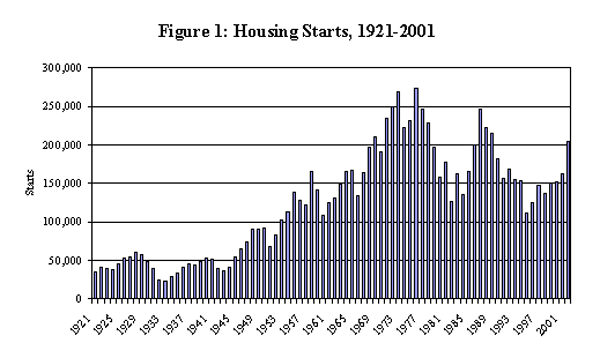
Prior to 1935, federal banking regulations restricted the participation of financial institutions in mortgage markets. Federal banking regulations and rigid loan repayment terms combined to make mortgage financing an expensive proposition for a large number of Canadians. The difficulty of accessing mortgage financing was identified as an important contributing factor in housing shortages. In 1935, in the depths of the Great Depression, the federal government tabled its first major piece of housing legislation, the Dominion Housing Act (DHA).(1)
The DHA enabled the federal government to make joint mortgage loans with approved private lending institutions to finance the building of new homes. Originally intended as a job creation measure to reduce chronic unemployment during the Great Depression, the Act effectively assisted the construction of residential housing by increasing the availability of first mortgage financing.
The first National Housing Act (NHA) succeeded the DHA in 1938. Like the Act it replaced, the NHA allowed the federal government to make joint mortgage loans with approved lenders. It also authorized special loans from unappropriated monies in the Consolidated Revenue Fund to local housing authorities for the construction of low-rent housing. The operation and administration of the Act was originally assigned to the Department of Finance. In 1944, legislative amendments to the NHA provided for the creation of a federal housing agency responsible for administering the NHA and other new federal housing policies.
Source: Statistics Canada and Canada Mortgage and Housing Corporation.
The following year saw the creation of the Central Mortgage and Housing Corporation(2) (CMHC), a Crown corporation specifically set up to administer the NHA. This initiative was originally designed to address issues related to post-war reconstruction and demobilization. CMHC’s role was to increase employment in the construction trades and expand construction of new housing in order to start rebuilding the housing stock, long neglected as a consequence of the Great Depression and World War II.
From 1935 to 1954, federal housing policy was primarily designed to increase residential construction activity by making mortgage credit available on very liberal terms in order to stimulate demand. During this period, it was believed that Canadian financial markets needed further growth and development to support the expansion of new housing construction. Government policy therefore sought to increase the efficiency of the private market and work with it to stimulate residential construction and upgrade housing conditions.
B. The
Mid- to Late Fifties: The Development of Mortgage Markets
and the Introduction
of
NHA Mortgage Loan Insurance
After 1954, federal housing policy shifted from stimulating construction demand to stimulating housing supply through increasing the availability of funds for residential construction. This shift in policy emphasis was reflected in changes to the NHA’s joint loan program and its mortgage instruments. The changes were aimed at correcting market imperfections and developing a secondary market for NHA mortgages.
In addition, the federal government entered the mortgage market during this period as a direct supplier of mortgage loans.(3) Acting as a financial institution, CMHC provided direct mortgage loans and joint mortgage loans with private lenders. When the third NHA became law on 18 March 1954, it introduced a significant addition to federal housing policy instruments: NHA mortgage loan insurance. Replacing the federal guarantee and joint loan program, the mortgage loan insurance program allowed the government to protect eligible private lenders by insuring them against borrower default.
Throughout the post-war period and the 1950s, federal housing policy was principally concerned with improving the functioning of the private housing market. By removing regulatory barriers to increase the volume of financing, the government sought to enhance the efficiency of capital markets, particularly the mortgage market. The government viewed its role as complementing the private sector in providing housing, rather than trying to compete against it in the construction of social housing or direct financing of housing assistance to poorer households. During this period, direct government provision of housing was the exception rather than the rule.
This policy was supported by housing statistics that confirmed that both the amount and quality of housing in Canada increased substantially during the post-war period.(4) Massive public-sector intervention in housing markets was not considered necessary, given the availability of new and existing housing on the private market and the fact that poorer households could secure housing through “filtering” – a process whereby high-to-middle-income households would purchase and occupy new housing, while the relative price of existing housing declined as the stock aged and thus became more affordable and more accessible to lower-income households. Only in the late 1960s, following a long period of continued economic prosperity, did social housing and income redistribution became the main thrust of housing policy.
It should be noted that, prior to 1964, housing policy was almost the sole prerogative of the federal government. The role of provincial and municipal jurisdictions was limited to the establishment of zoning laws, land use and building code regulations and, in some rare cases, low-income housing developments.(5)
C. The Sixties and Seventies: The Rise of Public Housing and Other Social Housing Programs
During most of the sixties and early seventies, North America benefited from a long period of continuous economic growth. With this rising tide of wealth came growing expectations that its benefits should be shared more equally amongst all members of society. It was widely believed that people were entitled to certain economic rights and that society, as a whole, had a responsibility to ensure that the basic needs of the less fortunate were met. This view was reinforced by a growing impatience in many parts of society with the resource allocation and income distribution outcomes of the private market. Such attitudes spurred governments into greater direct involvement in the economy to redress perceived unfairness and inequality in economic outcomes.
Accordingly, federal housing policy shifted away from encouraging market efficiency and moved towards promoting equity and income redistribution. Prior to the 1964 NHA amendments, housing policy, particularly with regard to public and social housing, had been the almost exclusive preserve of the federal government. Although some public housing was delivered by CMHC, the volume of this type of activity remained modest. The 1964 amendments to the NHA enabled the federal government to offer new financing and ownership arrangements for public housing that allowed greater provincial participation in the direct delivery of public and social housing. Public housing activity grew substantially afterwards.
In collaboration with the federal government, the provinces began to set up their own housing ministries or delivery agencies to implement public housing projects. Over time, however, conflicting priorities and interests made social housing a source of friction between the two levels of government. The growing provincial and territorial presence in this field encouraged claims that housing was exclusively under provincial jurisdiction, and provincial governments sought more control from the federal government over the design and implementation of social housing programs. One commentator was to remark about this period that “the development of housing programs was as much influenced by federal-provincial strategies as by the existence and nature of housing problems.”(6)
From 1946 to 1969, federally assisted housing starts accounted for 4.4% of all housing starts. This figure jumped to 18.0% in 1975, and to 32.5% in 1977-1978. Similarly, during the 1957-1969 period, 20% of CMHC direct lending had gone to low-income groups; by 1975, the proportion had soared to 99.7%.(7)
Housing policy in the sixties and seventies effectively became an instrument to redistribute income in favour of low-income households. Most new social housing programs included the construction or subsidization of new dwellings for low-income households, and the provision of rental assistance to tenants and cash grants to homebuyers.(8) Moreover, federal tax policy, especially the introduction in 1971 of the tax on capital gains realized on all financial and real estate investments (except principal residences), virtually eliminated the use of real estate as tax shelter. Thus, during the seventies, the combination of federal social housing programs and tax policy favoured investment in private homeownership and non-profit ownership of rental dwellings at the expense of for-profit “private” ownership of rental housing.
Public housing and other federal-provincial housing programs expanded rapidly until 1971. In that year, CMHC provided $308 million in mortgage loans for public housing, and almost 10% of all housing starts were for public housing. After 1971, the public housing program continued to expand but at a slower pace.
The continued expansion of public housing proved very expensive, however, because a substantial annual subsidy was required to bridge the gap between the actual cost of providing housing assistance and the rent paid by the tenant. Significant and rising operating costs, as well as other criticisms directed at public housing, led to two major reforms: a) the introduction of income mixing of tenants within housing projects, and b) the introduction of financial assistance to rehabilitate existing housing.
The first of these reforms involved integrating assisted households amongst households of different incomes in housing projects. This was done in response to criticisms regarding the high concentration of assisted households in public housing projects. It was held that a high density of assisted households within the same project would lead to the stigmatization of its tenants and to increased crime and vandalism, and that these problems would likely spread into surrounding neighbourhoods. The expanding urban blight would discourage economic activity and drive away needed public and private investment, further reinforcing the housing project’s physical decrepitude and the surrounding urban decay. Moreover, public housing projects were often poorly located, with tenants isolated from market access and job opportunities, far from friends and family, and deprived of other urban amenities – factors that further disadvantaged an assisted household. The integration of assisted households was also a costly form of aid, however, as low-income tenants would move into new and more expensive housing, further widening the gap between operating costs and subsidized rent.
As a means of implementing income mixing and dispersing assisted households, the Rent Supplement Program was created in 1975. Under this program, the federal government or a housing agency contracted with a private landlord to rent an apartment to a tenant from a public housing waiting list. The housing agency would pay the landlord the market rent, the tenant would pay a rent geared to his/her income, and the annual subsidy would be cost-shared between the federal and provincial/territorial governments under the terms of the agreement. The program never became widespread in the private sector, but it was extensively used to place low-income tenants into non-profit and co-operative housing projects.
The other main criticism levelled at public housing was that its introduction into neighbourhoods was usually preceded by the demolition of viable, low-income housing. This led to the second thrust of reform, which encouraged the repair and rehabilitation of older housing under the Residential Rehabilitation Assistance Program (RRAP). Introduced in 1973, the program encouraged the refurbishing of existing housing instead building of new housing. The RRAP was thus a more economical way of assisting eligible beneficiaries; for the same amount of funding, more people could be helped under the program. Accompanying this scheme was the Neighbourhood Improvement Program, which subsidized improvements to public infrastructure such as roads, public utilities and other community facilities.
In response to the cost of providing assistance and to other criticisms, the volume of public housing activity shrank while rent supplement and rehabilitation programs grew – although not rapidly enough to offset the drop in public housing activity. As a result, new social housing commitments(9) began declining after the early 1970s. However, the absolute level of government assistance continued to grow as the cost of supporting existing tenants in assisted housing continued to rise.(10)
The 1978 NHA amendments confirmed the commitment to income mixing of tenants within social housing projects. After 1978, CMHC substantially curtailed its mortgage lending activities for new public housing and federal-provincial assisted housing. Social housing programs now had to secure mortgage financing through private-sector lending institutions. This shift in the source of financing for social housing projects can be explained in large part by the federal government’s need to reduce public-sector borrowing requirements.
D. The Eighties: De-emphasizing Social Housing
The long string of annual budget deficits since the early 1970s imposed a significant financial burden on the federal government. This burden, together with competing spending priorities, compelled the government to carry out a comprehensive review of all program activities, including its social housing strategy. By the mid-eighties, the review had concluded that the strategy imposed heavy costs on the government without substantially altering income distribution or alleviating poverty. In fact, it had been observed that a large amount of social housing assistance actually went to middle- and high-income households.
Source: CMHC, Canadian Housing Statistics and Annual Reports (various issues).
As a result of these findings, many federal social housing programs were cancelled or merged with other programs, and greater effort was directed at targeting financial assistance to households in need. In 1985, CMHC launched a new Non-profit Program. This initiative sought to target low-income households and resumed federal-provincial cost sharing of housing projects. The federal government recognized the principle of provincial delivery of all social housing, but because national standards and federal money were involved, the federal government argued that CMHC should retain a role in broad policy development. Program delivery was subject to a global operating agreement between the two levels of government, as well as subsidiary operating agreements. The participating province or territory had to contribute at least 25% of the costs in order to be assigned responsibility for the delivery of the program. Under this new arrangement, all provinces with the exception of Ontario returned to public housing projects that exclusively served low-income tenants. The practice of income mixing in social housing projects was abandoned.
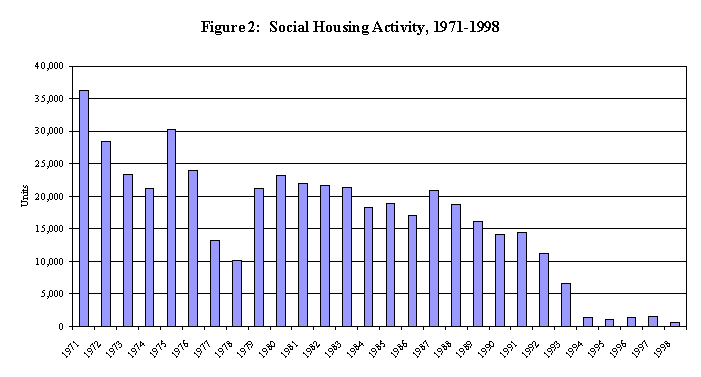
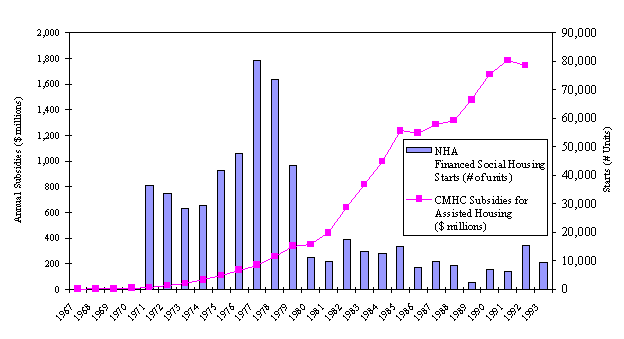
Despite pressures to control public spending on social housing, annual new commitment activity remained strong until 1987, when it amounted to 20,811 units. After 1987, social housing activity declined, but the cost to the federal government in subsidies continued to increase (see Figure 3) because operating costs rose faster than rents.
Figure 3: Social Housing Subsidies and Starts, 1967-1993
Source: CMHC, Canadian Housing Statistics and Annual Reports (various issues).
As a result of program review and budgetary restraint, the emphasis of federal housing policy in the 1980s shifted back in favour of promoting the efficiency of housing markets, and supporting market-based initiatives such as revitalizing the NHA insurance program and facilitating the growth of secondary mortgage markets through the introduction of mortgage-backed securities in 1984. Index-linked mortgages (ILM) were introduced, NHA mortgage loan insurance was extended to as much as 95% of the purchase price for first-time homebuyers, and first-time homebuyers were allowed to finance their housing purchases by borrowing up to $20,000 tax-free and interest-free from their Registered Retirement Savings Plan (RRSP).
In addition to these market-based initiatives, CMHC undertook a range of activities that included sponsoring housing research, providing support to domestic construction industries by making available such products as housing market analyses, promoting the Canadian construction industry abroad, fostering partnerships with international organizations and transferring CMHC expertise abroad.
E. The Nineties: Budgetary Constraint and Withdrawal from Social Housing
In the 1990s, efforts to contain budget deficits and control the growth of public debt imposed severe limits on federal social housing policy. During the first half of the decade, successive federal budgets progressively reduced the growth-rate of the social housing budget envelope. By the April 1993 Budget, the government had announced that the total funding allocated to the social housing portfolio would be capped at $2 billion per year. Funding would continue for special-purpose housing such as shelters for battered women and people with disabilities, and on-reserve housing. With the funding levels capped, only existing social housing commitments under federal/provincial agreements would continue to receive financial assistance. Delivery of new commitments ceased in 1993.(11)
Both the Rent Supplement Program and the Federal Co-operative Housing Program also ceased all new commitment activity, although funding continued to be allocated to existing units.
Furthermore, the NHA was amended to allow CMHC to directly finance social housing projects at low interest rates, to require owners of assisted housing projects to obtain CMHC approval before selling, and to delegate mortgage insurance processing to the provinces and municipalities.(12)
In 1996, the federal government announced that it would withdraw completely from social housing, with a few specific exceptions, and it began negotiations with provinces and territories for the devolution of operating authority for social housing programs. Any new federal funding for social housing commitments would have to be financed from savings generated by program efficiencies and targeted to on-reserve housing programs and to home renovation and repair programs. Federal expenditures on existing social housing commitments stand at approximately $2 billion per year, and currently support a portfolio of approximately 640,800 low-income households.(13)
F. The Late 1990s to the Early 21st Century: Coming Full Circle?
The present period is characterized by consolidation and rationalization of the federal government’s housing policy. While some special initiatives have been announced and implemented, there has been no major change in the policy’s orientation since the federal decision to withdraw from delivery of social housing and devolve its operational authorities to the provinces and territories.
Recently, federal budgetary appropriations have shifted in favour of those social housing programs transferred to provinces and territories. Parliamentary appropriations have been declining for the non-transferred portion of the federal social housing portfolio, with the notable exception of on-reserve and renovation programs.(14)
Table 1: Social Housing Appropriations
($ millions)
Fiscal Year |
RRAP/ Renovation Programs |
Rent Assistance |
Housing Supply* |
On- reserve Housing |
Program Transfer |
Total |
1989/1990 |
$147.3 |
$75.2 |
$1,332.2 |
$60.5 |
$1,615.2 | |
1990/1991 |
$135.3 |
$80.8 |
$1,500.7 |
$65.5 |
$1,782.3 | |
1991/1992 |
$128.7 |
$93.6 |
$1,515.3 |
$70.6 |
$1,808.2 | |
1992/1993 |
$107.7 |
$102.3 |
$1,566.9 |
$96.2 |
$1,873.1 | |
1993/1994 |
$71.0 |
$107.3 |
$1,569.6 |
$99.4 |
$1,847.3 | |
1994/1995 |
$52.7 |
$118.5 |
$1,622.0 |
$103.3 |
$1,896.5 | |
1995/1996 |
$55.5 |
$109.5 |
$1,582.0 |
$101.5 |
$1,848.5 | |
1996/1997 |
$68.5 |
$109.5 |
$1,577.3 |
$117.9 |
$1,873.2 | |
1997/1998 |
$59.8 |
$102.0 |
$1,190.4 |
$99.0 |
$250.8 |
$1,702,0 |
1998/1999 |
$71.1 |
$91.3 |
$1,126.5 |
$90.7 |
$388.7 |
$1,768.3 |
1999/2000 |
$93.3 |
$77.0 |
$809.7 |
$93.3 |
$739.1 |
$1,812.4 |
2000/2001 |
$108.0 |
$64.4 |
$522.6 |
$108.0 |
$106.4 |
$909.4 |
* Housing Supply includes Co-op Housing, Non-profit and Urban Native Housing, Rural an Native Housing/Public Housing, and Limited-Dividend Housing.
Regardless of the devolution, CMHC has continued to deliver new commitments. Of these, some 4% go to its On-reserve Non-profit Program and over 95% to strategic renovation and repair initiatives that include the Residential Rehabilitation Assistance Program (RRAP), the Emergency Repair Program (ERP), Home Adaptation for Seniors’ Independence (HASI) and the Shelter Enhancement Program (SEP). The level of new commitments increased from 10,839 new assisted households in 1997 to 24,850 assisted households in 2001.(15)
Table 2: New Assisted Households, 1996-2001
| Estimated Households Assisted Through New Commitments (Units) |
||||||
|
|
1996 |
1997 |
1998 |
1999 |
2000 |
2001 |
| Subsidy Programs |
|
|
|
|
|
|
| On-reserve Non-profit Program |
1,324 |
1,439 |
550 |
1,050 |
1,250 |
1,050 |
|
Repair Programs |
|
|
|
|
|
|
|
7,114 |
5,050 |
9,350 |
13,750 |
18,150 |
15,350 |
|
600 |
650 |
1,600 |
2,700 |
3,500 |
2,450 |
|
1,722 |
2,050 |
1,300 |
1,350 |
2,600 |
4,425 |
|
2,626 |
1,650 |
900 |
2,000 |
2,100 |
1,575 |
| TOTAL PROGRAMS |
13,386 |
10,839 |
13,700 |
20,850 |
27,600 |
24,850 |
|
Source: CMHC Annual Reports, 1996-2001 |
||||||
The recent rise in new commitments is attributable to increased funding of repair and renovation programs. In 1998, the federal government announced that it would maintain and upgrade the existing social housing stock and fund the creation of new units by injecting an additional $250 million over five years, plus an additional $50 million for housing renovations with priority given to assisting the homeless and those at risk of becoming homeless.
The following year, the National Homeless Initiative (NHI) was launched, as part of the federal government’s broader policy to address the issue of homelessness. The program is to provide $753 million over three years to ensure community access to programs, services and support for reducing and alleviating homelessness in major Canadian cities and rural communities across Canada. About $268 million of the total funding is to be allocated to the RRAP and related programs to renovate and upgrade existing housing stock targeted to low-income Canadians; the SEP would receive $43 million in additional funding to provide assistance to victims of family violence. The remainder of the funding is to support community-based initiatives that address youth and urban Aboriginal homelessness. According to its 2002-2006 Corporate Plan, CMHC expects annual levels of new commitments will begin to decline after 2003 once funding for the current NHI initiative expires.(16)
The homelessness strategy involves partnerships with all levels of government, the private sector and the voluntary sector. The NHI’s multidisciplinary approach reflects the current belief that there is no single cause of homelessness and that the problem requires interventions in a number of areas, including the provision of shelter, employment, mental health and welfare services, and programs to combat drug abuse. It is recognized that the homeless are a heterogeneous group, with specific needs and wants that will require authorities to respond with tailor-made solutions that are relevant to specific communities.
CMHC also recently introduced some innovations in its product and service lines to promote and enhance efficient and competitive housing markets. These innovations include extending 95% mortgage loan insurance coverage to all homebuyers, not just first-time homebuyers. In 2001, CMHC introduced the Canada Mortgage Bond (CMB) program to provide investors with a new vehicle to make secure investments in Canadian residential mortgages and provide the mortgage market with another competitive source of funds to lower mortgage financing costs for homebuyers.
Since the enactment of the Dominion Housing Act, there have been five distinct phases in the evolution of federal housing policy. The first phase, between 1935 and 1954, aimed to increase and renovate the private housing stock by applying policies and instruments that liberalized mortgage credit in order to stimulate construction demand. The second phase, from 1954 to 1964, was characterized by a shift from stimulating construction demand to stimulating housing supply; NHA mortgage loan insurance and direct lending were introduced to increase the availability of funds for residential construction. In both periods, the government saw its role as supporting the activities of residential construction by improving the functioning of credit markets.
This attitude changed dramatically in the 1960s and 1970s with increasing federal and provincial involvement in the delivery of social housing. Growing prosperity, changing attitudes toward government intervention, and dissatisfaction with market outcomes fuelled concerns about whether the benefits of economic growth were equitably shared amongst all members of society. No longer an economic commodity, housing became considered as a right, and it was felt that all Canadians were entitled to their fair share of shelter services. The 1964 NHA amendments reflected this attitude by enabling the federal government, along with the provinces and territories, to become more active in the direct provision of social housing through various programs such as public housing and non-profit housing, which subsidized the construction and purchase of rental accommodation. In fact, federal housing policy, through its various incentive programs and tax policies, actively encouraged private homeownership and public-sector ownership of rental dwellings, while at the same time discouraging investment in the private ownership of rental dwellings.
The fourth and fifth periods, which spanned the 1980s and 1990s, marked a progressive turnaround in housing policy as the growing financial commitment incurred by maintaining a large stock of social housing units, together with competing budgetary priorities, forced a reappraisal of federal housing policy. By the mid-nineties, the federal government had withdrawn completely from social housing and delegated its delivery to other levels of government. With a few specific exceptions, this period marks a return to the original aim of federal housing policy, that is, to provide support for the functioning of the private housing market and promote the Canadian construction industry at home and abroad.
(1) Jean-Claude Villiard, “The Canadian System of Housing Finance: Past, Present and Future,” Speech, Canada Mortgage and Housing Corporation, 8 November 2001.
(2) In 1979, the Central Mortgage and Housing Corporation was renamed the Canada Mortgage and Housing Corporation.
(3) Lawrence B. Smith, Anatomy of a Crisis: Canadian Housing Policy in The Seventies, Fraser Institute, Vancouver, 1977.
(4) Ibid., p. 14.
(5) Ibid., p. 136.
(6) George Fallis, “The Social Policy Challenge and Social Housing,” in Home Remedies: Rethinking Canadian Housing Policies, ed. John Richards and W. G. Watson, C. D. Howe Institute, Toronto, 1995, p. 9.
(7) Lawrence B. Smith, “Ontario Housing Policy: The Unlearned Lessons,” in Richards, ed. (1995), p. 141.
(8) Ibid.
(9) A social housing commitment is the government’s commitment to provide the cost-sharing funds to operate one dwelling unit.
(10) George Fallis, Housing Economics, Butterworths, Toronto, 1985, p. 173.
(11) Administered by CMHC, these agreements outlined the terms and conditions for cost-sharing and delivery of federal social housing programs. They were signed with all provinces except Prince Edward Island in 1986.
(12) The Canadian Tax Foundation, The National Finances 1993, Toronto, 1993.
(13) CMHC, Annual Report 2001, Ottawa, 2002.
(14) Ibid., p. 67.
(15) Ibid., p. 28.
(16) CMHC, Summary of the Corporate Plan: 2002-2006, Ottawa, 2001, p. 2.