This document was prepared by the staff of the Parliamentary Research Branch to provide Canadian Parliamentarians with plain language background and analysis of proposed government legislation. Legislative summaries are not government documents. They have no official legal status and do not constitute legal advice or opinion. Please note, the Legislative Summary describes the bill as of the date shown at the beginning of the document. For the latest published version of the bill, please consult the parliamentary internet site at www.parl.gc.ca.
LS-347E
BILL S-2: AN ACT TO FACILITATE THE
MAKING OF LEGITIMATE MEDICAL DECISIONS
REGARDING LIFE-SUSTAINING TREATMENTS
AND THE CONTROLLING OF PAIN
Prepared by:
Mollie Dunsmuir
Law and Government Division
26 October 1999
LEGISLATIVE HISTORY OF BILL S-2
HOUSE OF COMMONS |
SENATE |
||
| Bill Stage | Date | Bill Stage | Date |
| First Reading: |
|
First Reading: | 13 October 1999 |
| Second Reading: |
|
Second Reading: | 23 February 2000 |
| Committee Report: |
|
Committee Report: |
|
| Report Stage: |
|
Report Stage: |
|
| Third Reading: |
|
Third Reading: |
|
|
||
|
||
TABLE OF CONTENTS
BILL S-2: AN ACT TO FACILITATE THE
MAKING OF LEGITIMATE MEDICAL DECISIONS
REGARDING LIFE-SUSTAINING TREATMENTS
AND THE CONTROLLING OF PAIN
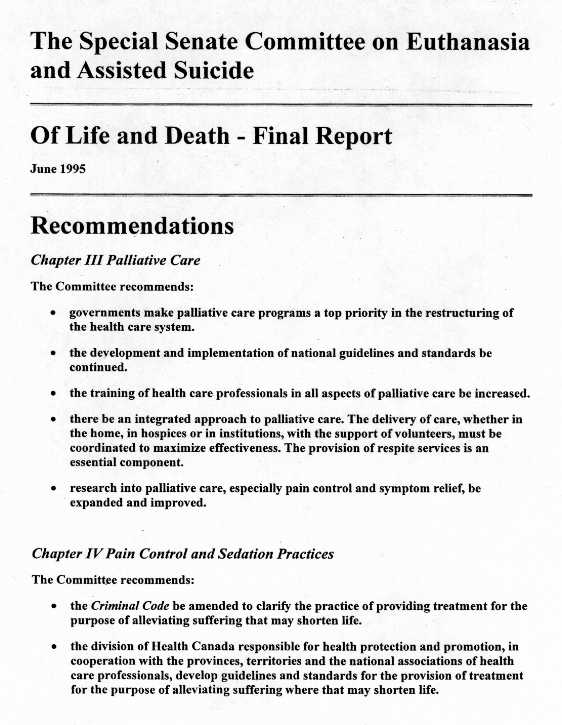
On 23 February 1994, a Special Senate Committee on Euthanasia and Assisted Suicide was appointed "to examine and report upon the legal, social and ethical issues relating to euthanasia and assisted suicide." On 6 June 1995, the Committee submitted its report, Of Life and Death, to the Senate. The Committee had begun by considering the scope of the Report, an issue that had generated considerable discussion:
The Committee found that it had to examine and become familiar with many of the current health care practices across Canada by medical practitioners, nurses, medical institutions and community services as well as the role that governments play in influencing and directing the provision of such services. . .
These other end-of-life considerations . . .must be explored in order to ensure that those who engage in future debate are fully informed of the wide ramifications of the issues. (p.3)
Accordingly, the Committee included chapters on:
- the terminology involved in end-of-life situations,
- palliative care,
- pain control and sedation practices,
- withholding and withdrawing of life-sustaining treatment, and
- advance directives.
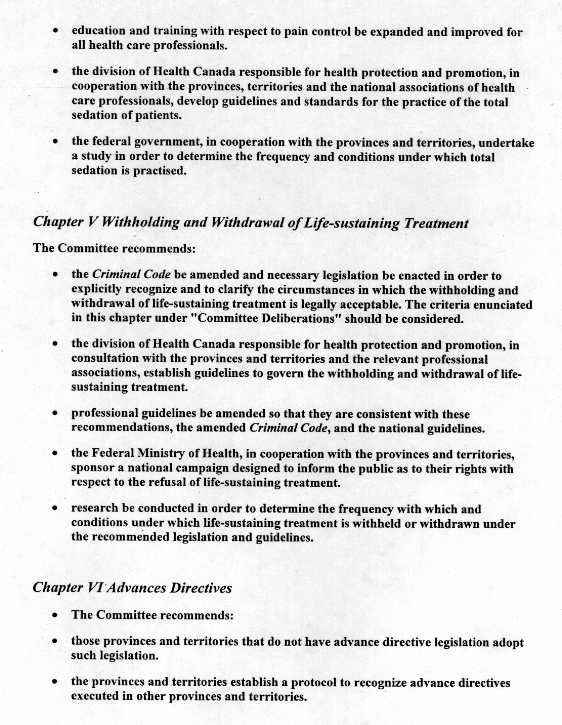
Although the Committee could not reach a consensus on all issues, the recommendations in these earlier chapters were unanimous, and are found in the Appendix.
In discussing the background to issues surrounding death and dying, and why these were of such great public interest, the Committee identified six different factors:
the advent of the Canadian Charter of Rights and Freedoms, which placed all individual rights within a significantly different legal and judicial context;
technological progress, which allows life to be increasingly prolonged and death to be postponed;
the difference between the view of some medical professionals that death represents a medical failure and the view of others, including palliative care specialists, that care of dying patients should be aimed at alleviation of suffering rather than a cure;
the dramatic shift whereby people are more likely to die in hospitals or long-term institutions, rather than at home;
the shift from the assumption that the doctor knows what is in the best interests of the patient to increased patient involvement and assumption of personal responsibility for choices; and
changing demographics, including an aging population and emerging at-risk groups such as HIV/AIDS patients.
The convergence of these factors led Committee members to conclude that they would first have to define the appropriate terminology and undertake a full discussion of palliative care, pain control, and the withholding and withdrawing of treatment.
Bill S-2 primarily seeks to implement the Committee recommendations on pain control and the withholding/withdrawing of life-sustaining treatment; it also touches on issues of terminology, palliative care and advance directives.
Bill S-2 begins with a preamble that situates the bill firmly within the context of the report of the Special Committee.
Clause 1 gives the short title of the proposed legislation, the Medical Decisions Facilitation Act. The Special Committee had recommended that the Criminal Code be amended to clarify and explicitly recognize in what circumstances it is legal to (a) withhold and withdraw life-sustaining treatment and (b) to provide treatment that aims to alleviate suffering but that may shorten life. As Bill S-2 also deals with other health issues in clause 6, however, a simple amendment to the Criminal Code was not possible.
Clause 2 would clarify that a health care provider can legally provide sufficient medication to alleviate physical pain, even if this requires dosages that might shorten the life of the person. The Special Committee recognized the present situation whereby "providing treatment aimed at alleviating suffering that may shorten life is legal. However, it also recognize[d] that there are misconceptions on the part of the medical profession and the public as to the current legal status of this practice" (p. 31). The confusion leads to fear of liability, which may in turn result in the administration of inadequate medication so that the patient suffers unnecessary pain. As well, a secretive medical environment makes it difficult to obtain data, thereby inhibiting research into pain control, and possibly even masking potential abuses.
The bill aims to clarify that protection from criminal liability applies only where the purpose of the medication is to alleviate pain, and is limited to the alleviation of physical pain. The Special Committee had used the broader terminology "alleviation of suffering," but clause 2 narrows the scope and excludes situations where medication might be administered to alleviate emotional or psychological suffering. Moreover, clause 2 would not provide protection where another ground of criminal liability, such as criminal negligence, might exist. Finally, clause 2 specifically does not apply to "mercy killing" situations, where there is an intention to cause death.
A "health care provider" is defined as a person qualified to practise medicine who is responsible for the treatment and care of the person involved, or a nurse or other person working under the direction of the medical practitioner. This recognizes the fact that it is very often nurses, working under the instruction of a physician, who are responsible for ongoing pain control.
Clause 3 would clarify that there is no criminal liability when a health care provider withholds or withdraws life-sustaining medical treatment from a person, provided that the person, while competent, has made a valid request for such action, in accordance with clause 3(2). Alternatively, clause 3(3) then sets out the procedure required to obtain such permission when the person is not competent.
"Life-sustaining medical treatment" is defined as any medical or surgical procedure intended to prolong life, including artificial hydration and nutrition. The Special Committee gave the following definitions and examples:
The Committee has defined withholding life-sustaining treatment as not starting treatment that has the potential to sustain life -- for example, not instituting cardiopulmonary resuscitation (CPR); not giving a blood transfusion; not starting antibiotics; or not starting artificial hydration and nutrition.
Withdrawing life-sustaining treatment is stopping treatment that has the potential to sustain life. Examples include removing a respirator or removing a gastric tube supplying artificial hydration and nutrition. (p. 37)
Clause 3(2) deals with the situation where a competent person makes a "free and informed request" that treatment be withheld or withdrawn. The definitions of "free and informed" and "competent" in Bill S-2 are very close to those used in the Report of the Special Committee:
"Free and informed consent" means the voluntary agreement by a person who in the possession and exercise of sufficient mental capacity, as defined by an appropriate medical professional, makes an intelligent choice as to treatment options. It supposes knowledge about the consequences of having or not having the treatment and about possible alternatives. The consent must be free from coercion, duress and mistake. (p. 15)
"Competent" means capable of understanding the nature and consequences of the decision to be made and capable of communicating this decision. (p. 13)
The bill would clarify that a competent person is able to consent in advance to end-of-life health care decisions, through a written directive, or "in writing or by words or signs," provided there is one witness who is not a health care provider.
Clause 3(3) deals with the situation where a person becomes incompetent before having made a decision. In that case, a request to withhold/withdraw treatment could be made by (1) a proxy appointed under provincial law; (2) if there is no proxy, a legal representative having the authority to make personal health care decisions for the patient; or (3) if there is neither a proxy or a personal health care representative, the person most intimately associated with the patient.
Clause 4 is the definition section; the definitions of "competent," "free and informed request," "health care provider," and "life-sustaining medical treatment" have been discussed above.
Clause 5 states that nothing in the Act would impose a duty to provide medical treatment. One of the purposes of the Act is to clarify that a patient can make the decision to refuse treatment, but such a decision has no effect on the provision of treatment. If a health care professional feels that treatment is futile, he or she is under no new obligation to provide it. Similarly, if a health care professional feels uncomfortable with providing a level of pain control that may shorten life, the bill clarifies that he or she is not under any new obligation to provide it.
Clause 6 recognizes that many of the recommendations of the Special Committee involve the need for research and guidelines. Because the issues surrounding pain control and withholding/withdrawing of treatment fall so much into a "grey" area, accurate information tends not to be available. Bill S-2, by clarifying the legal situation, should greatly assist in making such data available, but the need for education and guidelines would continue. Because the provinces play such an important role in health care, the clause makes clear that Minister of Health’s mandate could include coordinating, with provincial authorities and professional health care associations, the establishment of national guidelines for withholding/withdrawal of treatment, pain control and palliative care. The Minister of Health would also be authorized to encourage public education with respect to pain control and palliative care. Clause 6 also proposes that the Minister be given the mandate to monitor the effects of S-2 on the withholding and withdrawal of treatment.